

Metamaterials and Their Applications
Our metamaterials research started in 2001 and it was aimed for microwave and industrial applications. Our work has covered a very broad range of research topics in metamaterials, which include electromagnetic bandgap structures, high impedance surfaces and partial reflective surfaces. Our work on left-handed metamaterials is mainly based on numerical modelling. Due to its dispersive nature of metamaterials, the conventional FDTD method has to be modified to tackle both frequency and spatial dispersions. Once the limitation of left-handed metamaterials was uncovered, we have investigated many alternative materials and structures to enable applications such as directive and compact antennas, subwavelength imaging and broadband microwave systems. Our modelling capability was extended to the modelling of invisibility cloaks. Meanwhile, it has offered us an opportunity to work on the exciting concept of transformation optics/electromagnetics. We are currently working with our partners under the funding of EPSRC QUEST Programme Grant with the aim to apply both transformation optics and metamaterials to practical applications at microwave frequencies. More information please visit the QUEST project website at http://quest.eecs.qmul.ac.uk.
1. Flat Lens Modelling and Layered LHM Structures
Left-handed materials (LHMs) are those engineering composites that the electric permittivity and the magnetic permeability of a material are both negative. This was noted theoretically a while ago; in 1968, Victor Veselago [1] of the Lebedev Physics Institute in Moscow concluded LHMs exhibiting an anti-parallel nature in its wave and Poynting vectors which is opposite to conventional materials that normally electromagnetic waves carry energy in the same direction as they propagate, following what's called a right-hand rule. Exciting possible electrodynamic properties, such as reverse Doppler shift, Cherenkov radiation and inverse Snell effect, were identified. But his idea was forgotten because of the unavailability of LHMs at that time and until recently, Pendry et al [2] demonstrated that materials with an array of split ring resonators (SRRs) produce negative permeability over certain frequency bands. Soon afterwards, by combining a two-dimensional (2D) array of SRRs interspersed with a 2D array of wires, Smith et al [3] demonstrated for the first time the existence of LHMs.
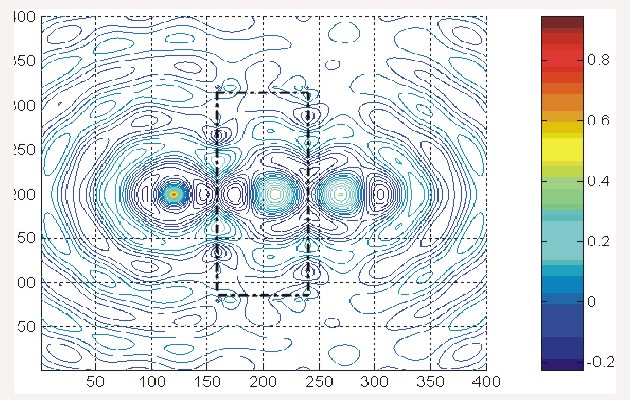
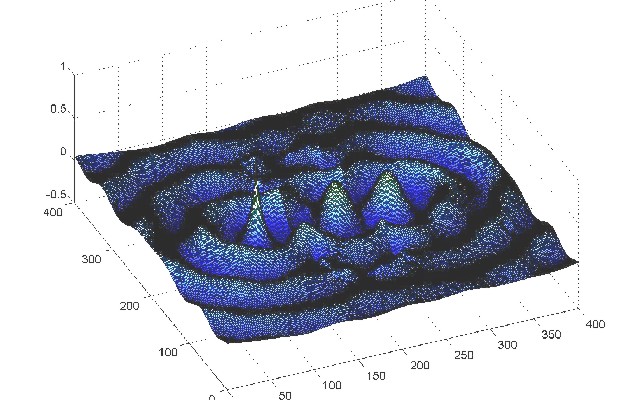
Dispersive FDTD Simulation at QMUL verifying possible construction of Perfect Lens
from LHMs predicted by Pendry [5]
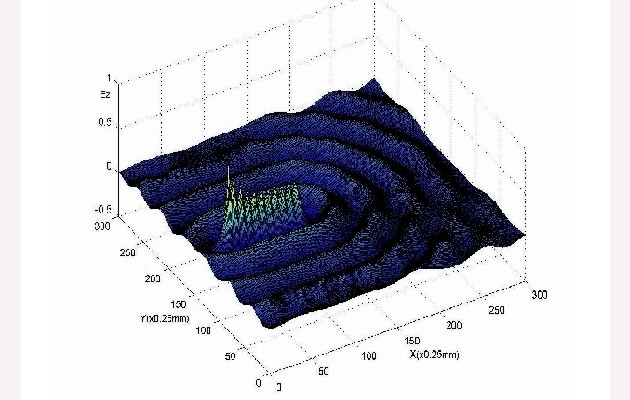
A snapshot of the near field (Ez) image through a multi-layer LHM slab
2 . Wire Medium Imaging
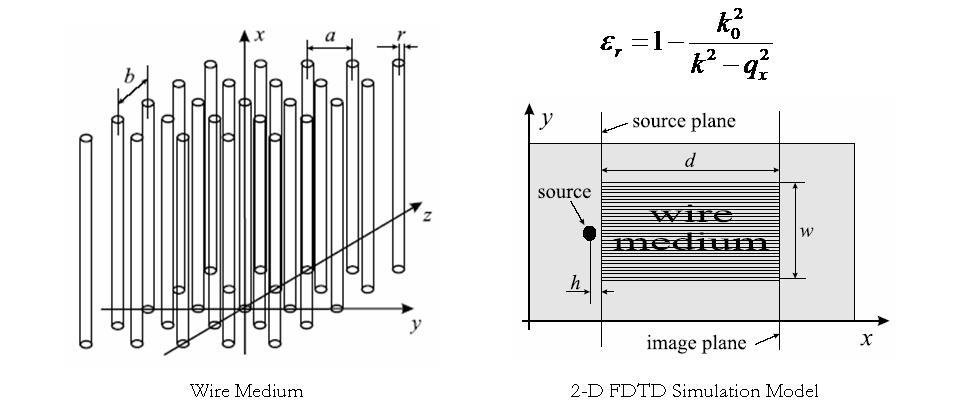
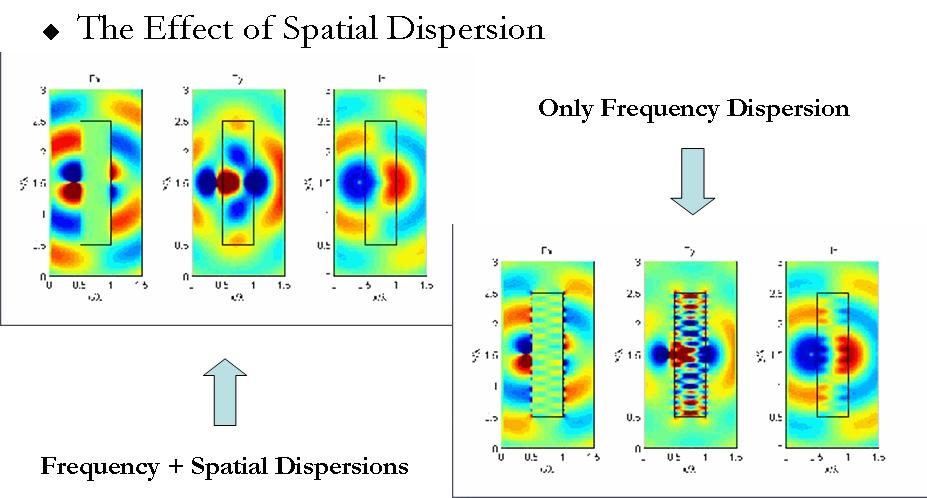
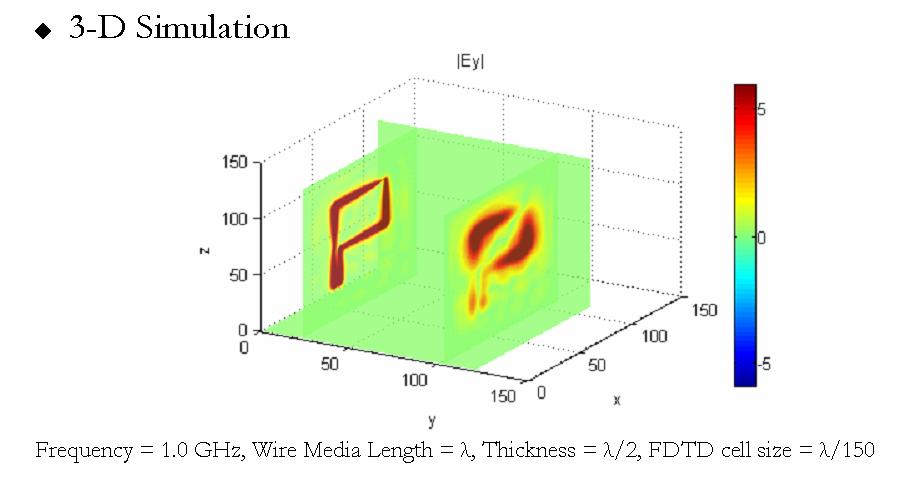
We have investigated, through numerical simulation whether or not the finite transverse dimensions of LHM slabs influence the quality of their sub-wavelength imaging. However, in practice, the fabrication of left-handed media remains problematic, since it requires the creation of negative permeability, which does not exist in nature. Furthermore, currently available designs of the left-handed media are very lossy at both microwave and optical frequencies are very lossy, which restricts and even prevents their use in sub-wavelength imaging applications. There is an alternative approach to sub-wavelength imaging in the sense of mapping the source distribution in one plane onto another (the imaging plane). This approach involves neither the use of left-handed media nor does it capitalize on negative refraction or amplification of evanescent waves, which has been referred to as canalization. It is based on transporting both the propagating and evanescent spectra of a source by transforming them into propagating waves inside a slab of specially designed materials. Then, these propagating modes are capable of transporting sub-wavelength images from one interface of the slab to the other. The source must be placed very close to the front interface of the slab in order to minimize the degradation of its spectrum which occurs when the fields propagate in the free space. It is also necessary to minimize the reflection from the slab via an appropriate choice of its thickness. This is done by tuning the slab thickness for Fabry-Perot resonance, to reduce reflections from its interface for a wide range of angles of incidence, and minimize the interfering interactions between the source and the slab that can distort the image. The material operating in the canalisation regime should have a flat iso-frequency contour, implying that, it should support waves traveling in a certain direction with fixed phase velocity for any transverse wave vectors. The materials that fulfil this requirement are available at both microwave and optical frequency ranges. One such artificial material, is the wire medium comprising of, a regular array of parallel metallic wires.
3. 95GHz Woodpile EBG Antennas
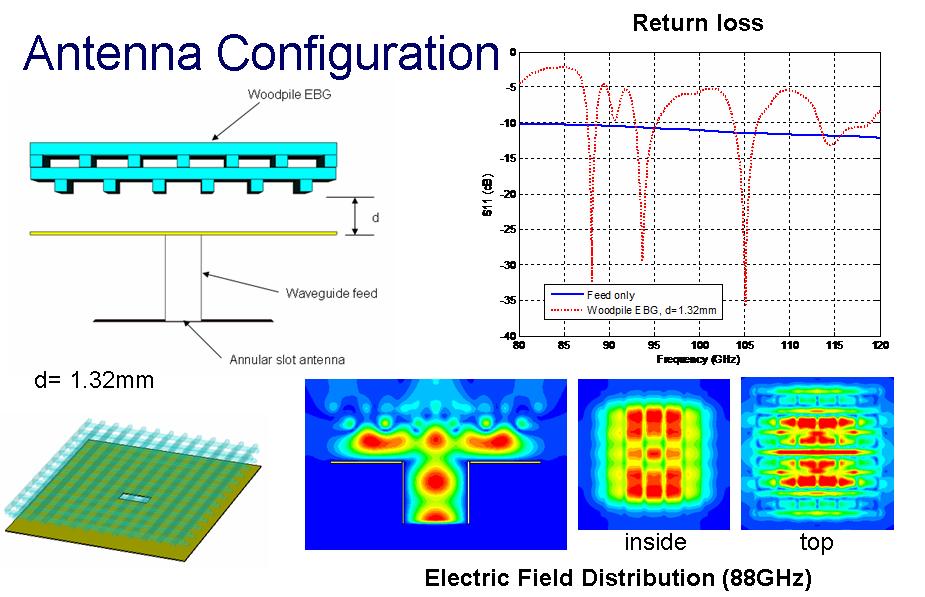
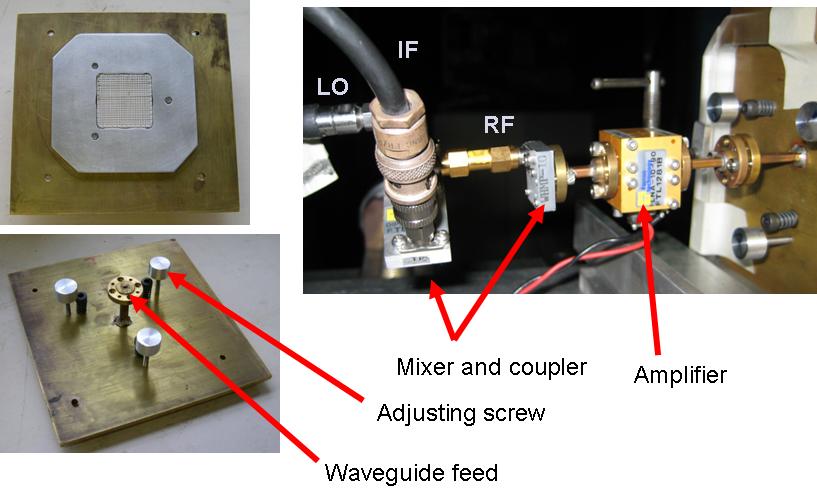
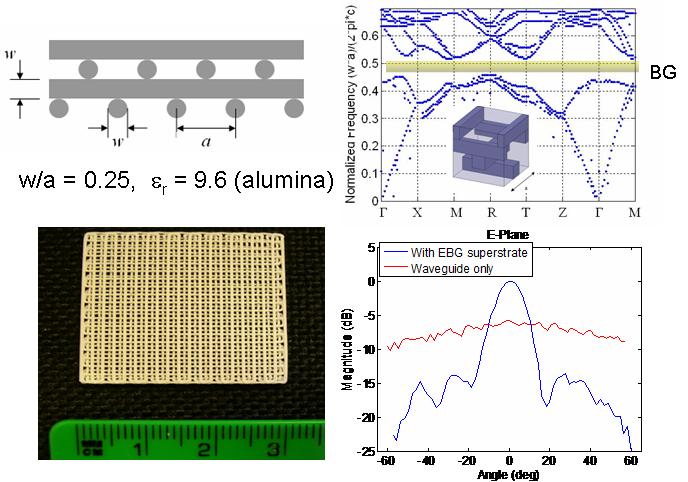
Millimetr e wave systems are becoming increasingly important in many applications because they can provide wider bandwidth for transmitting large amount of data and better resolution in radar systems. Electromagnetic Bandgap ( EBG ) structures, a class of metamaterial and also known as photonic bandgap structures (PBG) in optics, are now finding numerous applications at microwave and millimetr e wave frequencies . The full potential of EBG structures can be utilised with a full three dimensional (3D) bandgap. Thus rapid and cost-effective fabrication techniques for 3D EBG structures are of significant importance. A woodpile structure shown in the figure exhibits a full 3D bandgap and can be easily fabricated for applications at microwave frequencies using columns of individually machined dielectric rods . However, at millimetr e wave frequencies, conventional machining would not be convenient because of small dimensions (50–500 m m). Various sophisticated techniques such as silicon lithography are available for microstructures, but those are more appropriate for terahertz and photonic wavelength applications, and would be costly to fabricate 3D structures with large number of layers for applications at W-band (75-110 GHz). In this work, we present a direct rapid prototyping method for constructing 3D EBG materials for millimetrewave applications, with a possible extension to higher frequencies based on extrusion freeforming of ceramic materials. The proposed fabrication method can also be versatile for constructing curved geometries and creating defects in layered structures.
References
1. Veselago, V.G., " The electrodynamics of substances with simultaneously negative values of and ," Sov. Phys. Usp., Vol.10, No.4, 509-514, Jan-Feb, 1968.2. Pendry, J.B.; Holden, A.J.; Robbins, D.J.; Stewart, W.J. 'Magnetism from conductors and enhanced nonlinear phenomena' Microwave Theory and Techniques, IEEE Transactions on, Volume: 47 Issue: 11, Nov. 1999 Page(s): 2075 -2084
3. Smith, D.R.; W.J. Padilla; D. C. Vier; S. C. Nemat-Nasser, and S. Schultz, "Composite media with simultaneously negative permeability and permittivity," Phys. Rev. Lett. , Vol.84, 4184-4187, 2000
4. Garcia N, Nieto-Vesperinas M, "Left-handed materials do not make a perfect lens", PHYS REV LETT 88 (20): art. no. 207403 MAY 20 2002
5. Y. Hao, L. Lu and C. G. Parini, 'Dispersive FDTD Modeling on Multi-layer Left-Handed Meta-Materials for Near/Far Field Imaging At Microwave Frequencies', the 2003 IEEE AP-S International Symposium on Antennas and Propagation and USNC/CNC/URSI North American Radio Science Meeting, Columbus, Ohio, USA on June, 2003.
7. Chiyan Luo, Steven G.Johnson, and J.D. Joannopolous, J.B Pendry ‘Negative refraction without negative index in metallic photonic crystals’, Optics Express, Vol.11,No.7, April 7, 2003
8. P.V Parimi, W.T.Lu, P.Vodo, J.Sokoloff, S.Sridhar, ‘Negative Refraction and Left-handed electromagnetism in Microwave Photonic Crystals’, cond-mat/0306109, 2003
9. Y. Hao, S. Sudhakaran and C. G.Parini, ‘Spatial Harmonics Effects On Characterisation Of Left-Handed Metamaterials’, Asia-Pacific Microwave Conference, Korea, Nov., 2003.
For more information on our research, please contact Prof. Y. Hao .